 ultimate-guide
How to Build Immersive Worlds: A 2026 Guide
Table of Contents
- What Makes an Immersive World Believable
- Define Your Story's Needs and Core Elements
- Worldbuilding for Game Masters: A Structured Approach
- RPG Setting Creation: Balancing Depth and Playability
- Worldbuilding Examples for D&D and Other Systems
- Immersive Storytelling in Tabletop RPGs: Showing, Not Telling
- Maintain Internal Consistency and Continuity
- Test Your World and Refine
- Frequently Asked Questions
Last Updated: October 14, 2026
What Makes an Immersive World Believable
To build immersive worlds, you need internal rules that are consistent, details that serve the story, and settings readers or players can navigate without constant explanation. Believability isn't about size or complexity, it's about coherence.
The global immersive entertainment market was valued at $137.7 billion in 2025 according to Grand View Research, with projections reaching $1,024.6 billion by 2033 at a 29.4% compound annual growth rate.
What separates a forgettable setting from one that haunts players long after the campaign ends? Specificity. Generic taverns blur together. The difference is balancing broad worldbuilding with memorable details that make the world feel lived-in.
The brutal world of Doxis works because it doesn't explain everything at once. The clash of sorcery and savage technology creates immediate tension, and players discover how that tension shapes culture, politics, and survival. That's immersion.
Define Your Story's Needs and Core Elements
Before you sketch a map or invent a pantheon, ask what your world actually needs to serve. A murder mystery in a small town requires different worldbuilding than an epic fantasy spanning continents. Define the scope first, then build only what serves it.
Identify your story's core conflict: political intrigue, survival against hostile forces, exploration of forbidden territories, or something else. Your core elements, the handful of distinctive features that define the world, should all connect back to that conflict.
Choose three to five core elements maximum. More than that and you're building a world instead of serving a story.
Test each element: Does this make the story stronger, or am I adding it because it's cool? Cool worldbuilding that doesn't serve the narrative becomes exposition, and exposition kills immersion. Keep only what matters.
Worldbuilding for Game Masters: A Structured Approach
Game Masters face a unique challenge: your world must be deep enough to feel real, but flexible enough to respond to unpredictable player choices. Structure matters more than volume of content.
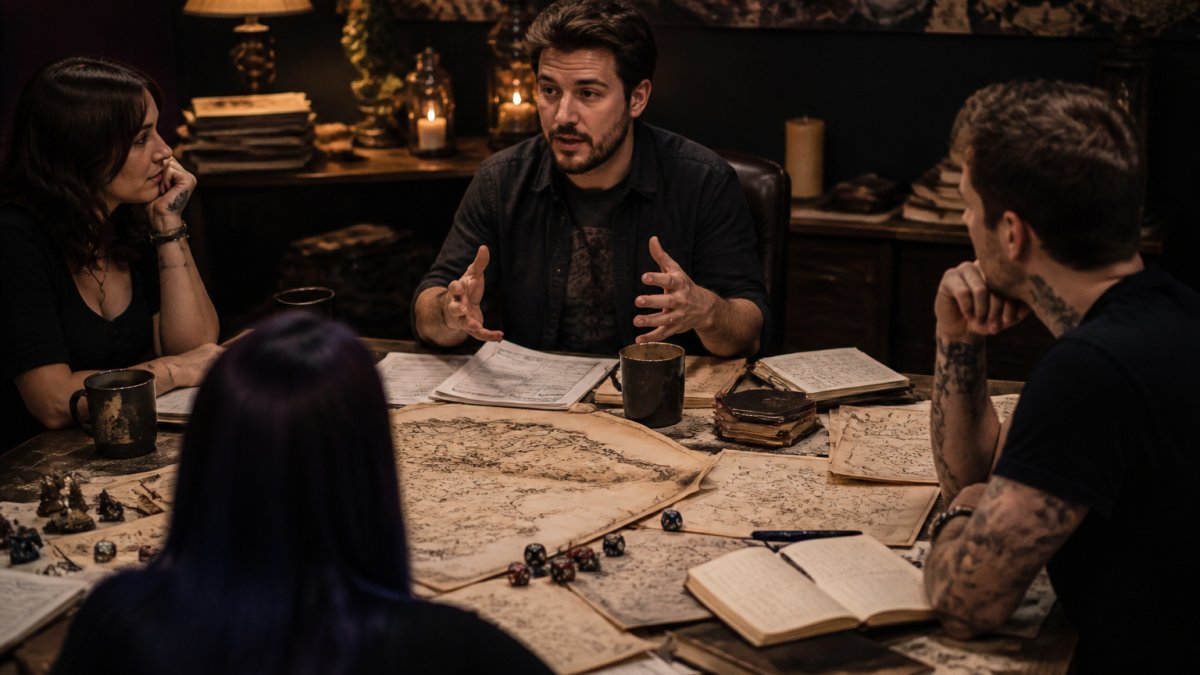
Start with what players will encounter first and detail that thoroughly; leave the rest as sketches. If your campaign begins in a city, know that city inside out, its districts, key NPCs, factions, and immediate conflicts.
Document your world's rules explicitly. How does magic work? What are its limits and costs? What technology exists and why? Write these down. When players push boundaries, and they will, you need consistent answers.
Establish Geography and Locations
Geography shapes everything: culture, economy, conflict, and narrative possibility. A world isolated by mountains develops differently than one connected by navigable rivers. Deserts create scarcity; forests create concealment.
Start with the map your players will actually use. It doesn't need to be beautiful, just functional and consistent. Include distances, travel times, and terrain features that matter. A swamp isn't just atmospheric, it's impassable in spring, it breeds disease, it slows armies. Details like these make geography a force in the story, not decoration.
Name specific locations and describe what makes them distinctive. "The capital city" is generic. "Kethral, where the sorcerer's tower casts a shadow across half the city at dawn, and the streets follow patterns older than anyone remembers" gives players something to grip.
Build History, Lore, and Historical Continuity
History explains why the world is the way it is, the answer to every "but why?" question. A kingdom's laws make sense if you understand the war that shaped them. A culture's taboos matter if you know what disaster they're meant to prevent.
You don't need centuries of history, just the events that directly impact your story. What happened fifty years ago that still affects politics today? What conflict created the current power structure? What discovery or disaster changed everything?
Write history as turning points, not chronology. "The Sundering happened three hundred years ago" is useless.
Create continuity by referencing history in the present. NPCs mention old grudges. Ruins hint at lost civilizations. Traditions preserve forgotten purposes. When players encounter the past, they feel the weight of time.
Create Cultures, Societies, and Belief Systems
Culture makes a world feel inhabited. It's how people think, what they value, how they treat strangers, what makes them angry. A society's beliefs shape its laws, architecture, food, and art.
Define three to four core cultural groups. For each, identify: What do they value most? What do they fear? What do they consider taboo? How do they treat outsiders? What's their relationship to magic, technology, or power?
Belief systems don't need elaborate theologies. They need to explain how people understand the world and justify their place in it. In Doxis, where sorcery and savage technology clash, belief systems split between those who see one as salvation and the other as corruption.
Avoid monocultures. Even small worlds have competing beliefs, practices, and values. Show the friction between them. That friction is where stories live.
Design Political Relationships and Power Structures
Politics is how power flows through your world: who has it, how they use it, and who wants to take it. Without political structure, your world feels empty.
Identify the major factions or power centers. Not necessarily good versus evil, just groups with competing interests. A merchant guild might clash with a religious order. A noble house might struggle against a rising military faction.
Map the relationships: Who allies with whom? Who despises each other? Who are uneasy partners? Document at least three active conflicts or tensions. These become the hooks that pull players into your world's politics.
Political structure should create natural story opportunities. If a faction is losing power, players might be hired to accelerate that collapse or defend it. If a new leader is rising, players might become key to their success or downfall.
RPG Setting Creation: Balancing Depth and Playability
The trap most Game Masters fall into: trying to build immersive worlds so detailed they can't run them. They've created an encyclopedia when they needed a toolkit.
Depth and playability aren't opposites. You achieve both by preparing detail where it matters and leaving room for improvisation elsewhere. Your players won't explore every corner, they'll carve a specific path. Prepare that path thoroughly; sketch everything else.
Use a tiered approach: Level 1 is what players encounter immediately, detailed completely. Level 2 is what they might encounter soon, with notes, key NPCs, and rough conflicts. Level 3 is everything else, one-sentence descriptions, improvisation, or "we'll figure this out when they go there."
This keeps your preparation focused and your world playable. You're not trying to have all answers, just the right answers when they matter.
Worldbuilding Examples for D&D and Other Systems
Different systems demand different worldbuilding approaches. D&D favors clear power hierarchies, distinct factions, and locations built for exploration and combat. Other systems might prioritize character relationships, moral ambiguity, or resource scarcity.
For D&D specifically, build your world around dungeons, ruins, and locations, the stage where most of the game happens.
For narrative-heavy systems like Powered by the Apocalypse games, focus on relationships between factions and NPCs. The world emerges through how characters interact with it.
For sandbox or exploration-focused games, emphasize geography and discovery. Players need enough world to explore that they feel genuine choice about where to go. Include hidden locations, rumors that lead somewhere, and rewards for thorough exploration.
Regardless of system, the principle is the same: build what your system and your players will actually use.
Immersive Storytelling in Tabletop RPGs: Showing, Not Telling
The biggest mistake Game Masters make is explaining the world instead of revealing it.
Use sensory details. Describe how a place smells, sounds, and feels, not just how it looks. "The tavern reeks of spiced ale and wet leather" is more immersive than "It's a typical tavern." Show conflict through action and dialogue, not exposition.
Reveal history gradually. Drop hints. Let players piece together what happened. When they discover something, make them feel clever for understanding it. That's immersion: the moment the world clicks into place because the player figured it out themselves.
Use NPCs as windows into your world. A merchant describes trade routes and economic tensions. A soldier reveals military structure and morale. A priest explains belief systems through what they preach and what they avoid discussing.
Maintain Internal Consistency and Continuity
Consistency is the foundation of immersion. When the world contradicts itself, players stop believing in it.
Keep a continuity document. Write down what you've established: NPC names and positions, locations and features, rules about how magic or technology works, historical events you've mentioned. When improvising, check it. It takes thirty seconds and prevents contradictions that break immersion.
When you make a mistake, and you will, handle it gracefully.
Test your world's internal logic. If magic is rare and dangerous, why do commoners treat it casually? If a faction controls a region, how do they enforce that control? If a location is important, why isn't it better defended?
Test Your World and Refine
Your world isn't finished when you start the campaign. It evolves as players interact with it. The best Game Masters treat worldbuilding as an ongoing process, not a checklist.
Run a session and pay attention to what worked and what didn't. Did players care about the political conflict you designed? Did the geography create interesting challenges?
Ask your players what they want to explore. Their interests should shape what you develop next. If they're fascinated by a faction you sketched lightly, develop it more.
| Element | Focus | Frequency |
|---|---|---|
| Geography | Map, distances, terrain effects | Once, then reference |
| Core conflicts | Faction goals, tension points | Every session |
| NPCs | Motivations, reactions, dialogue | As encountered |
| History | Relevant backstory, consequences | When discovered |
| Rules | Magic, technology, limits | When tested |
Immersion comes from consistency, specificity, and letting players feel the world's weight. Build what matters. Detail what they'll encounter. Leave room for improvisation.
The immersive worlds that endure are the ones where players feel their choices matter, where the setting responds authentically, and where every detail serves the story.
Frequently Asked Questions
What makes a fictional world immersive?
An immersive world combines internal consistency, sensory details, and clear connections between geography, culture, and plot. When every element reinforces the others, when a desert culture's architecture, religion, and politics all reflect scarcity, players feel the world is real and lived-in. Believability comes from specificity: distinctive locations, memorable characters, and rules that govern how magic, technology, or society actually work.
How much worldbuilding should a game master do before a campaign?
Start with core elements: the story's central conflict, 3-5 distinctive locations, and the power structures that drive tension. Avoid over-building before players arrive, they will create questions you can't anticipate. Build the world progressively as the campaign unfolds. A complete geography, full history, and every NPC's backstory will sit unused. Focus on depth in areas players will explore.
How can you reveal world lore without overwhelming players with exposition?
Show lore through NPCs, locations, and consequences rather than dialogue dumps. A crumbling temple tells history. A character's accent and values reflect culture. Let players discover lore through exploration, NPC conversation, and earned rewards. Scatter clues across sessions so players piece together the story themselves. This transforms passive listening into active discovery, which deepens immersion and memory.
What details make a tabletop RPG setting feel lived-in?
Lived-in worlds include sensory details (smells of a market, sounds of a tavern), daily routines of NPCs, visible signs of history (scars on the land, aging buildings), and unrelated subplots happening around the party. Include minor factions, trade routes, and conflicts that exist independent of the player characters. When players see the world continues without them, it feels authentic.
How do worldbuilding examples for D&D differ from other RPG systems?
D&D emphasizes fantasy tropes, dungeon exploration, and magic systems tied to divine and arcane sources. Other systems may prioritize science fiction, horror, or urban settings with different core rules. The worldbuilding process is the same, establish geography, culture, and power structures, but the specific details and genres shift. Choose your core elements based on the system's strengths and your players' expectations.
How can player choices shape a campaign setting?
Design your world with branching consequences: if players destroy a faction, that power vacuum affects future encounters. Let NPC relationships and political alliances shift based on player decisions. Track how locations change after key events. This creates a dynamic world where players feel their actions matter, deepening immersion and investment in the story.
ParadoxisRPG's Player's Manual and GM's Guide provide the structured framework you need to build and maintain immersive worlds like Doxis. With tools for managing consistency, developing factions, and balancing depth with playability, you'll spend less time managing contradictions and more time running compelling campaigns. Explore how ParadoxisRPG's comprehensive materials help you master brutal, thematic worldbuilding.